
Field welding presents challenges that extend beyond the welding process itself. Contractors must coordinate machinery, fuel, transportation, work crews and site access while maintaining the required welding output. On remote construction sites, pipeline projects and industrial maintenance locations, equipment selection can directly affect how efficiently teams complete their assigned work.
Working with experienced Shindaiwa Welding Distributors helps industrial buyers identify equipment suited to their operating conditions and production requirements.
Shindaiwa equipment available through Fabricast includes engine-driven welding generators and wire-feeding equipment for industrial applications. Depending on the model, these solutions can support stick welding, wire-fed welding and other suitable field applications.
The key is to select equipment around the actual worksite requirements rather than treating every project as the same type of welding operation.
Why Engine-Driven Welding Equipment Matters on Site
Not every welding location has convenient access to a suitable electrical supply. Infrastructure construction, pipeline installation, field repairs and remote maintenance may require equipment capable of operating independently of a permanent workshop power source.
Engine-driven welding generators combine a welding power source with an engine-driven system. Certain models also provide auxiliary electrical power, depending on their specifications.
For field contractors, this configuration can simplify equipment planning by bringing essential capabilities together in one machine.
When evaluating Shindaiwa welding generators, consider the following:
- Required welding current and output characteristics
- Welding process and electrode or wire requirements
- Duty cycle at the intended operating current
- Number of operators working simultaneously
- Auxiliary power requirements
- Fuel consumption and operating duration
- Machine dimensions and transportation arrangements
- Service access and routine maintenance requirements
These factors help determine whether a particular generator is appropriate for the project and the conditions in which it will operate.
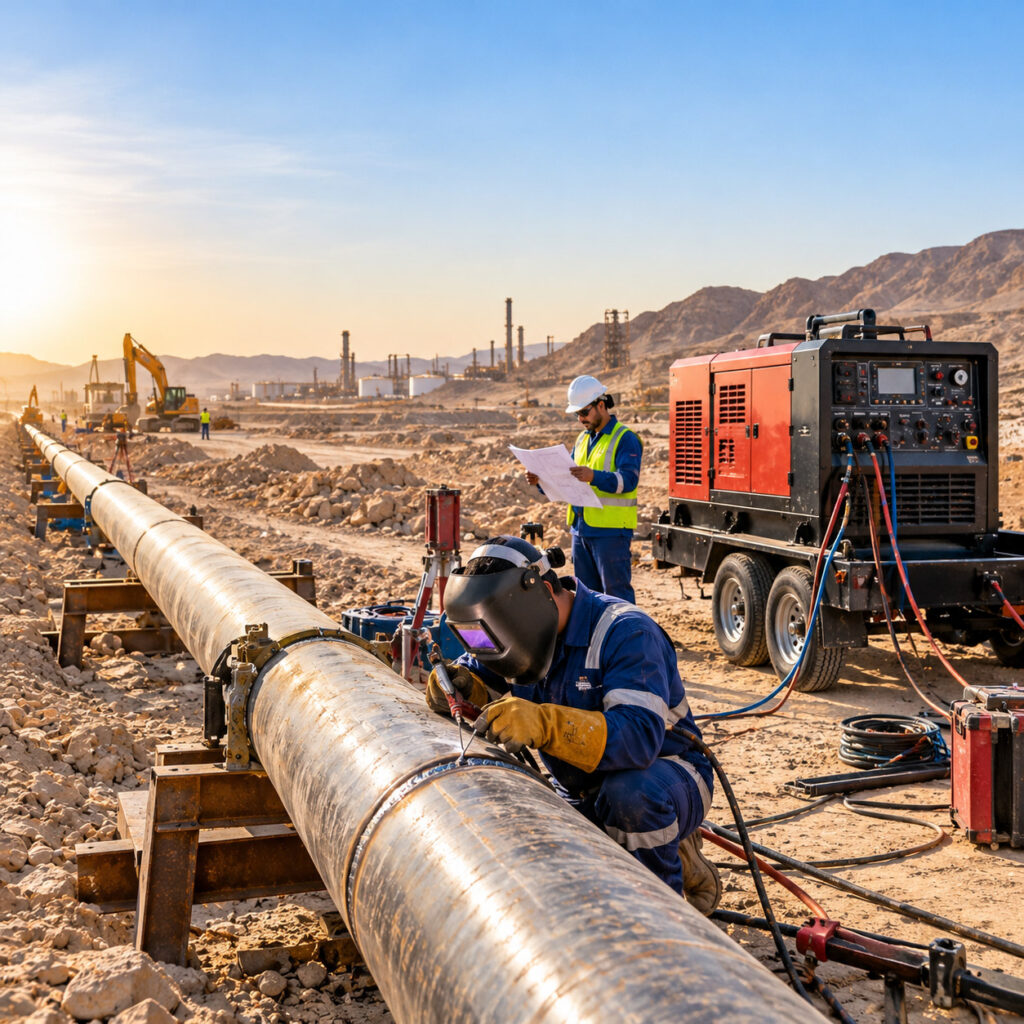
Selecting Equipment for Pipeline and Structural Work
Pipeline construction and structural fabrication often involve long work shifts, changing work locations and multiple welding activities taking place across a project site.
The equipment must be suitable for the required welding process, material specifications, joint configuration and approved welding procedures.
For pipeline contractors, the selection process should begin with the welding procedure specification, required current range, electrode classification and expected production workload.
For structural steel projects, important considerations include material thickness, joint preparation, welding position and the number of welds expected during each shift.
Suitable Shindaiwa industrial welding equipment can then be evaluated against these requirements.
Fabricast lists models including the DGW400DML/UKV, DGW500DM, DGW600DM-AC/RT and DGW600DM/RT. Each model has its own operating characteristics, so buyers should review the relevant technical documentation before selecting a machine.
A project-specific assessment is particularly important when welding quality requirements, operating hours and site conditions are demanding.
When a Dual-Operator Welding Generator Is Useful
Large projects may require two welding operators to work at the same location. Using a suitable dual-operator generator can help consolidate equipment requirements, provided its outputs meet the needs of both operators.
Fabricast lists the Shindaiwa DGW600DM/RT as a dual-operator welding generator designed for heavy-duty industrial applications. Its published specifications describe simultaneous outputs of 300A for two operators at a 100% duty cycle under the stated operating conditions.
Before choosing a dual-operator configuration, assess:
- The current required by each welding procedure.
- Whether both operators will work simultaneously.
- The duty cycle needed for each application.
- Whether the machine supports the required welding processes.
- The location of each workstation and cable-routing requirements.
- The operating conditions specified by the manufacturer.
A dual-operator arrangement should be selected only when the machine’s technical limits align with the intended workload.
For contractors seeking Shindaiwa diesel welding generators, this assessment can help identify an appropriate configuration for larger field operations.
Wire Feeders for Wire-Based Welding Applications
Wire-fed welding processes can be useful in suitable fabrication environments where productivity, consistent wire delivery and the required weld characteristics are important.
A wire feeder moves welding wire from its spool to the welding torch at a controlled rate. Its compatibility with the power source, wire type, torch assembly and intended process must be confirmed before use.
Fabricast lists Shindaiwa wire-feeding equipment, including the SWF500-GS and SWF500K.
When sourcing Shindaiwa wire feeders, verify:
- Compatibility with the welding power source
- Supported wire types and diameters
- Feed mechanism and drive configuration
- Required torch and cable connections
- Intended welding process
- Availability of compatible replacement components
For a project using flux-cored or solid wire, selecting the complete equipment configuration is important. The power source, feeder, torch, wire and welding procedure must work together as a suitable system.
Plan Equipment Around Site Logistics
A welding machine may have sufficient output for a job but still be difficult to deploy if the site logistics have not been considered.
Remote work areas can involve uneven access routes, limited unloading space, long distances between work fronts and restrictions on where machinery can be positioned.
Before arranging delivery, project managers should confirm the machine’s dimensions, lifting points, transportation requirements and placement conditions.
Fuel storage, routine service access, ventilation and protection from environmental exposure should also be included in the site plan.
When comparing Shindaiwa welding equipment suppliers, ask about the product specifications, operating documentation, availability and support arrangements relevant to the equipment being considered.
A clear mobilization plan helps ensure that the machine can be transported, positioned and prepared for operation safely.
Maintenance Planning for Consistent Availability
Industrial equipment availability depends on more than initial performance. Routine inspections and maintenance are important for keeping machinery in suitable operating condition.
Engine-driven welding generators require attention to the engine and welding system in accordance with the manufacturer’s maintenance schedule.
Depending on the model, routine checks may include engine oil, air filters, cooling arrangements, fuel-system condition, electrical connections and visible damage. Maintenance intervals and service procedures should always follow the relevant product documentation.
A practical maintenance plan should identify who is responsible for inspections, how operating hours are recorded and how faults are reported.
For companies purchasing Shindaiwa welding machines, access to the correct manuals, service information and compatible parts should be considered as part of the equipment procurement process.
These preparations can help maintenance teams organize servicing and reduce avoidable interruptions.
Choosing a Distributor for Industrial Requirements
Industrial buyers often need to coordinate equipment specifications, project schedules, delivery requirements and after-sales questions through the procurement process.
A suitable distributor should be able to clarify the available product options and help buyers identify the information needed to make an informed decision.
When contacting Shindaiwa welding equipment distributors, prepare the application details, required output, welding process, expected operating hours and project location.
If the project involves multiple machines, explain whether the equipment will operate independently or as part of a coordinated welding setup.
Fabricast lists Shindaiwa welding generators and wire feeders on its website and serves industrial customers through its regional operations in the UAE, Qatar, Saudi Arabia and Kuwait.
For buyers looking for Shindaiwa welding suppliers GCC, regional coverage may be useful when coordinating equipment requirements across different project locations. Product availability and support arrangements should be confirmed for the specific order.
Shindaiwa Equipment Through Fabricast
Fabricast supplies industrial welding and cutting equipment for construction, fabrication, maintenance and other applications.
Its Shindaiwa range includes diesel-powered welding generators for different operating requirements and wire-feeding equipment for compatible wire-based welding processes.
Businesses evaluating Shindaiwa welding solutions can begin by identifying the required output, operating environment, number of welding operators and expected work schedule.
These details help establish which product specifications need to be reviewed before a purchase decision is made.
Explore the Shindaiwa equipment range at Fabricast or submit your project requirements through the Fabricast Request a Quote page.
Conclusion
Choosing the right engine-driven welding equipment requires a clear understanding of the worksite, welding process, output requirements and project logistics.
Pipeline contractors, infrastructure teams and industrial maintenance providers should evaluate current requirements, duty cycle, operator capacity, mobility and maintenance needs before selecting a generator or wire-feeding system.
For businesses searching for Shindaiwa Welding Distributors, Fabricast provides access to a range of Shindaiwa welding generators and wire feeders for industrial applications.
Prepare your technical requirements and discuss the intended application with the supplier to identify an appropriate equipment configuration for your project.
Call to Action
Looking for Shindaiwa welding equipment for your next industrial project?
Contact Fabricast to discuss your requirements for welding generators, dual-operator machines or wire-feeding equipment. Share your welding process, required output, project location and operating conditions to request a suitable quotation.
Frequently Asked Questions
1. What types of Shindaiwa welding equipment are available through Fabricast?
Fabricast lists Shindaiwa engine-driven welding generators and wire-feeding equipment. The suitable product depends on the application, required output and model availability.
2. Are Shindaiwa welding generators suitable for field operations?
Engine-driven welding generators can support suitable field applications where an appropriate permanent electrical supply is unavailable. Confirm the machine’s specifications and operating requirements for the intended worksite.
3. What should I consider when choosing a dual-operator welding generator?
Review the required output for both operators, simultaneous operating requirements, duty cycle, welding processes and the manufacturer’s operating limits.
4. How do I select a compatible Shindaiwa wire feeder?
Check compatibility with the power source, supported wire types and diameters, torch connections and intended welding process before purchasing.
5. How can I request Shindaiwa equipment from Fabricast?
Visit the Shindaiwa product page or submit a quotation request with your application, technical requirements, quantity and delivery location.
