
ESAB Distributors UAE provide advanced welding equipment and reliable solutions for the country’s growing fabrication, construction, manufacturing, oil and gas, and maintenance sectors. Fabricast supports businesses in selecting suitable ESAB welding machines based on their applications, materials, production demands, and working environments, helping industrial teams achieve consistent weld quality, improved productivity, and dependable performance across demanding projects.
Why Welding Productivity Begins Before the Arc Starts
When companies experience welding delays, the welding machine itself is not always the problem.
Production time can also be lost through parameter setup, moving equipment between work areas, changing processes, handling consumables, correcting inconsistent welds, or waiting for maintenance.
This means an effective welding equipment strategy should examine the complete workflow.
Before investing, a fabrication business should understand:
- Which materials are welded most frequently
- Typical material thickness
- Required welding processes
- Daily operating hours
- Production volumes
- Workshop and field conditions
- Operator experience
- Future project requirements
Working with experienced industrial welding equipment suppliers UAE can make this assessment easier and help prevent overspending on unnecessary capabilities.
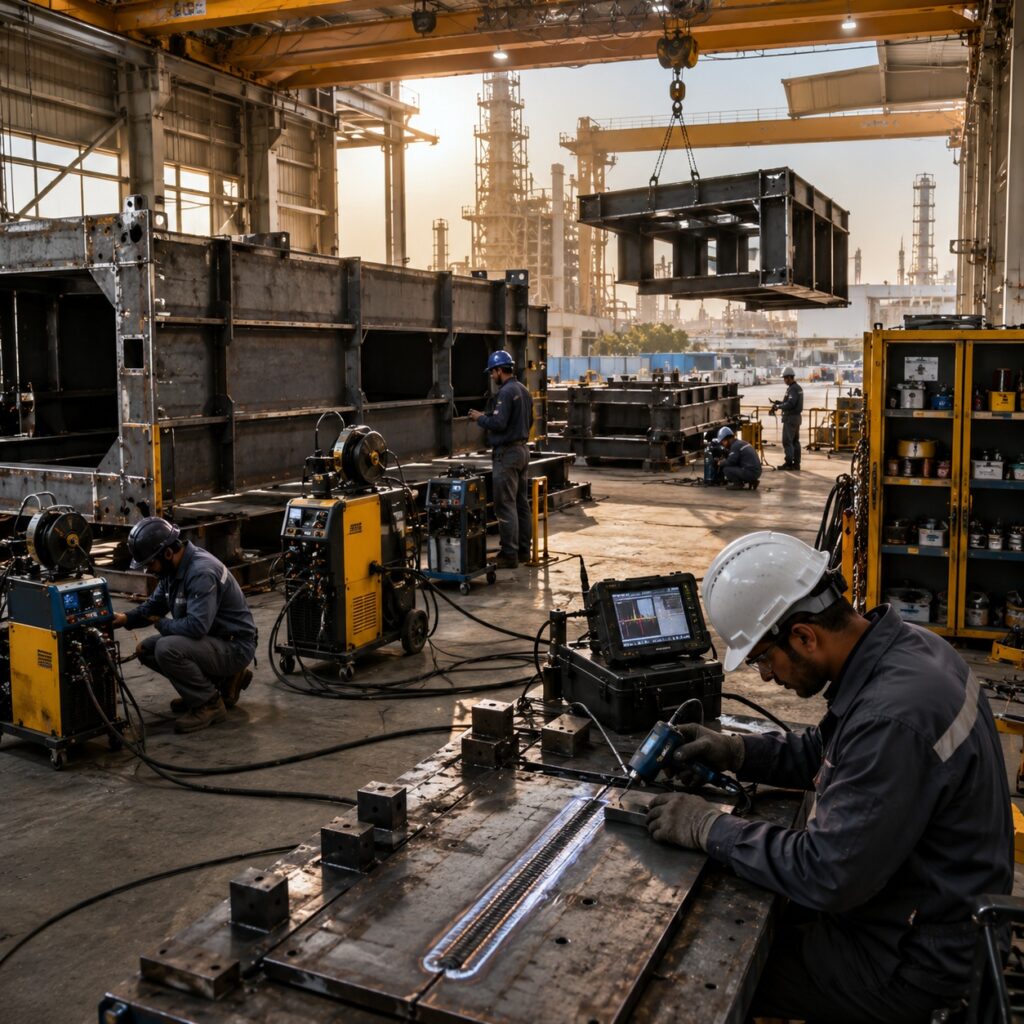
ESAB Welding Technology for Different Production Environments
There is no single welding machine suitable for every industrial operation.
ESAB’s current equipment categories include MIG/GMAW, TIG/GTAW, Stick/SMAW, multi-process systems, battery-powered welders, wire feeders, and weld-data solutions.
The correct technology depends on what the workshop actually produces.
MIG Welding for Production-Oriented Fabrication
MIG welding is particularly valuable in environments where productivity and repeatability are priorities.
Typical applications can include:
- Structural steel fabrication
- Equipment manufacturing
- General metal fabrication
- Industrial assemblies
- Production welding
Businesses considering ESAB MIG welding machines should evaluate more than amperage. Wire-feeding performance, process requirements, duty cycle, operator controls, and compatibility with the intended consumables can all influence productivity.
ESAB also offers heavy-duty inverter systems such as the Fabricator EM 500i, designed for MIG/MAG and MMA welding in industrial environments.
TIG Welding When Control Matters
Not every workshop is chasing maximum deposition speed.
For precision fabrication, control and weld appearance may be more important.
TIG welding is commonly associated with applications involving stainless steel, aluminium, specialized assemblies, and work where a clean, controlled weld is required.
When selecting ESAB TIG welding equipment, buyers should consider:
- Material type
- Material thickness
- AC or DC requirements
- Current range
- Cooling requirements
- Welding duration
- Portability
ESAB’s wider welding portfolio includes TIG systems alongside its other welding processes.
The objective should be to match machine capabilities to the type of precision work actually performed.
Stick/MMA Welding for Flexible Site Operations
UAE contractors and industrial maintenance teams do not always operate inside controlled workshops.
Equipment may need to move between construction sites, plant maintenance areas, pipelines, and remote working locations.
In these environments, MMA welding can provide valuable flexibility.
For example, ESAB’s Rogue ES series is designed around professional Stick welding, with digital controls and portability among its highlighted characteristics.
For companies evaluating ESAB MMA welding machines UAE, portability should be considered alongside durability, electrode requirements, input power, and expected operating conditions.
Multi-Process Capability: Useful or Unnecessary?
A multi-process machine can be attractive because one system may support several welding processes.
But businesses should ask whether that flexibility will actually be used.
A workshop performing one process throughout every shift may benefit more from equipment optimized specifically for that workload. A maintenance department handling unpredictable jobs, however, may gain considerable value from multi-process capability.
ESAB currently markets multi-process welding equipment as part of its welding portfolio.
Before investing in multi-process welding systems, consider how frequently each process will be required and whether consolidating equipment will simplify operations.
Don’t Ignore Wire Feeding
Wire feeding can have a major influence on MIG/MAG welding performance.
Production interruptions caused by inconsistent feeding, unsuitable setup, or worn components can reduce the benefit of a capable power source.
ESAB’s UAE/MEA product portfolio includes wire feeders, MIG guns, MIG consumables, and related accessories in addition to welding power sources.
When specifying a complete system, businesses should evaluate the power source and feeding arrangement together.
This is particularly relevant for heavy industrial welding solutions, where equipment may be expected to operate under sustained production conditions.
Equipment Selection Should Reflect the UAE Working Environment
The UAE presents operating conditions that deserve consideration during equipment selection.
Some machines remain inside organized fabrication workshops. Others may operate in industrial plants or outdoor project environments where heat, dust, movement, and demanding schedules affect daily operation.
Buyers should therefore consider:
- Cooling performance
- Ventilation
- Equipment enclosure
- Cable management
- Machine mobility
- Input power stability
- Maintenance accessibility
Selecting a technically capable machine without considering its operating environment can create unnecessary problems later.
Think in Terms of Welding Stations, Not Individual Machines
One way to improve equipment procurement is to stop viewing the welding machine as an isolated purchase.
Instead, think about the complete welding station.
A productive station may require:
- Power source
- Wire feeder
- Welding torch
- Work return cable
- Consumables
- Gas equipment
- PPE
- Work positioning
- Fume management
ESAB’s broader fabrication offering spans welding equipment, filler metals, torches, gas-related equipment, PPE, cutting, automation, and digital solutions.
Planning the complete professional welding workstation can help reduce compatibility issues and create a more organized production environment.
Where ESAB Equipment Fits Across UAE Industries
The UAE has a diverse industrial economy, meaning welding requirements vary considerably between sectors.
Structural Fabrication
Steel fabricators need reliable welding performance for beams, frames, platforms, supports, and engineered assemblies.
Productivity and consistent weld output become especially important when large quantities of similar components must be completed within tight project schedules.
Oil, Gas and Process Industries
Energy-related fabrication and maintenance may involve piping, structural assemblies, equipment supports, repair work, and shutdown activities.
Equipment selection should always reflect approved welding procedures and project-specific requirements.
Shipbuilding and Marine Engineering
Marine operations may require welding for new fabrication, maintenance, structural repairs, and equipment manufacturing.
ESAB identifies shipbuilding, pipelines, power generation, repair and maintenance, process industry, transportation, and other sectors among industries served by its fabrication technologies.
Manufacturing
Manufacturing companies often prioritize repeatability, efficient setup, operator usability, and predictable production output.
Choosing appropriate welding solutions for manufacturing can help reduce unnecessary process variation.
Repair and Maintenance
Maintenance departments typically encounter diverse welding tasks.
Portable and versatile equipment may be particularly valuable when teams work across multiple locations within a facility.
How Much Welding Power Do You Actually Need?
A common purchasing mistake is assuming that more amperage automatically represents a better investment.
The correct power range depends on material, electrode or wire requirements, thickness, welding process, and expected workload.
Overspecifying equipment can increase capital costs without delivering meaningful productivity benefits.
Underspecifying equipment creates a different problem: the machine may struggle to support the required duty cycle.
A better approach is to document typical jobs and select equipment around realistic operating conditions.
Duty Cycle Deserves Serious Attention
Two welding machines can appear similar until production begins.
If one is expected to weld intermittently while another runs for extended periods at higher output, their operational requirements are very different.
Duty cycle becomes especially important for:
- Production fabrication
- Heavy engineering
- Long welds
- Multi-shift operations
- High-amperage applications
Businesses choosing industrial ESAB welding machines should evaluate duty-cycle requirements against their real production patterns.
Inverter Technology and Workshop Efficiency
Modern inverter-controlled welding systems can combine compact construction with responsive welding control and improved portability, depending on the model.
ESAB’s Arc 400i, for example, uses an IGBT-based inverter design and highlights efficient power usage and portability.
These characteristics can be valuable in workshops where machines frequently move between welding stations.
However, inverter technology alone should not determine the purchasing decision. Buyers should evaluate the complete machine specification and its suitability for their workload.
Standardizing Equipment Can Simplify a Growing Workshop
As fabrication businesses expand, equipment is often purchased project by project.
Eventually, the workshop can become filled with unrelated machines, accessories, torches, consumables, and controls.
Standardization can simplify:
- Operator training
- Consumable management
- Spare parts planning
- Equipment allocation
- Maintenance
- Troubleshooting
Working with ESAB welding equipment suppliers can help businesses develop a more structured procurement strategy rather than buying machines independently whenever new requirements appear.
Don’t Treat Consumables as an Afterthought
Welding productivity depends on more than the power source.
Consumable selection affects weld quality, process stability, productivity, and project compliance.
ESAB’s fabrication portfolio includes covered electrodes, cored wires, solid wires, TIG rods, strips, fluxes, and other filler-metal solutions.
Procurement teams should therefore evaluate equipment and consumables together, particularly where project welding procedures specify particular materials or classifications.
The Real Cost of Welding Equipment Is Bigger Than the Purchase Price
Machine price is easy to compare.
Operational cost requires more thought.
Businesses should consider:
- Electricity consumption
- Consumables
- Maintenance
- Replacement components
- Operator time
- Downtime
- Rework
- Equipment lifespan
A machine that improves workflow reliability may deliver greater long-term value even if another option initially appears cheaper.
This total-cost perspective is particularly important for businesses operating equipment across multiple shifts.
Why Technical Support Matters
A distributor’s role should extend beyond supplying equipment.
Industrial customers may need help interpreting machine capabilities, selecting appropriate equipment, understanding accessories, and planning around production requirements.
When evaluating ESAB Distributors UAE, businesses should consider the quality of technical and after-sales support alongside product availability.
A strong supplier relationship can be particularly valuable as production requirements evolve.
Why Choose Fabricast for ESAB Welding Solutions in the UAE?
Fabricast supports industrial businesses seeking welding, cutting, and fabrication equipment for professional applications.
For customers considering ESAB solutions, equipment selection can begin with practical questions:
What material are you welding? Which process is required? How frequently will the equipment operate? Is the machine intended for workshop or site use? What level of portability is required? What are your future production plans?
By answering these questions first, businesses can make more informed purchasing decisions.
Customers searching for ESAB Distributors UAE can approach Fabricast for guidance on welding solutions aligned with their production and project requirements.
Pre-Purchase Checklist for UAE Buyers
Before requesting a quotation, prepare the following information:
- Welding process required
- Base materials
- Material thickness
- Typical amperage
- Daily welding hours
- Available electrical supply
- Workshop or field use
- Portability requirements
- Required accessories
- Future production expectations
This information gives the supplier a clearer picture of the application and can lead to a more appropriate equipment recommendation.
Conclusion
The best welding equipment investment is not necessarily the machine with the highest output or the longest feature list. It is the system that fits the production environment and continues to deliver reliable performance as operational demands change.
For UAE manufacturers, contractors, fabricators, and maintenance teams, this means evaluating welding process, materials, duty cycle, portability, operator requirements, consumables, and long-term support before purchasing.
Working with experienced ESAB Distributors UAE can simplify this process. Fabricast helps industrial customers evaluate welding solutions around practical application requirements, enabling businesses to build more efficient, organized, and productive fabrication operations.
Frequently Asked Questions
1. What is the focus keyphrase?
The focus keyphrase is ESAB Distributors UAE.
2. What welding equipment does ESAB offer?
ESAB’s current portfolio includes MIG, TIG, Stick/MMA, multi-process and other welding equipment, along with wire feeders, torches, consumables, automation, cutting products, and related fabrication solutions.
3. How do I choose the right ESAB welding machine?
Start with the required welding process, materials, thickness, duty cycle, electrical supply, operating environment, and expected production volume.
4. Is a multi-process welder suitable for every workshop?
Not necessarily. Multi-process capability is most valuable when a business genuinely requires multiple processes. Dedicated equipment may be more appropriate for highly repetitive production.
5. Why does distributor support matter?
Professional support can help businesses select appropriate equipment and accessories while providing assistance with technical and after-sales requirements.
