
Every fabrication operation has its own production requirements. A workshop manufacturing metal enclosures may prioritize precise heat control and a clean finish, while a structural steel contractor may need equipment suitable for repetitive welding across multiple assemblies. Maintenance teams face a different challenge: selecting versatile machines for repairs involving different components and working conditions.
Choosing JASIC Welding Equipment starts with understanding these differences.
JASIC offers welding and cutting products across several categories, including MIG, TIG, MMA (stick), plasma cutting, multi-process welding, welding accessories and consumables. This range gives industrial buyers multiple equipment configurations to consider for different applications.
For businesses sourcing welding machinery through Fabricast, the goal should be to identify equipment that matches the work, supports the required welding procedure and fits the practical conditions of the workshop or project site.
Start With the Workpiece, Not the Machine
Before selecting a welding machine, define the work it will perform.
Material type, thickness, joint design and production volume all influence the appropriate equipment configuration. A machine suitable for light fabrication may not provide the output or operating characteristics needed for demanding industrial production.
Begin by identifying:
- The metals and thicknesses being processed
- The required welding process
- The joint types and welding positions
- The expected production volume
- The available electrical supply
- The required operating duty cycle
- The level of operator control needed
- The accessories and consumables required
- These details help narrow the available options and make equipment comparisons more meaningful.
When evaluating JASIC welding machines, compare the technical specifications of individual models rather than relying on the brand name or maximum current rating alone.
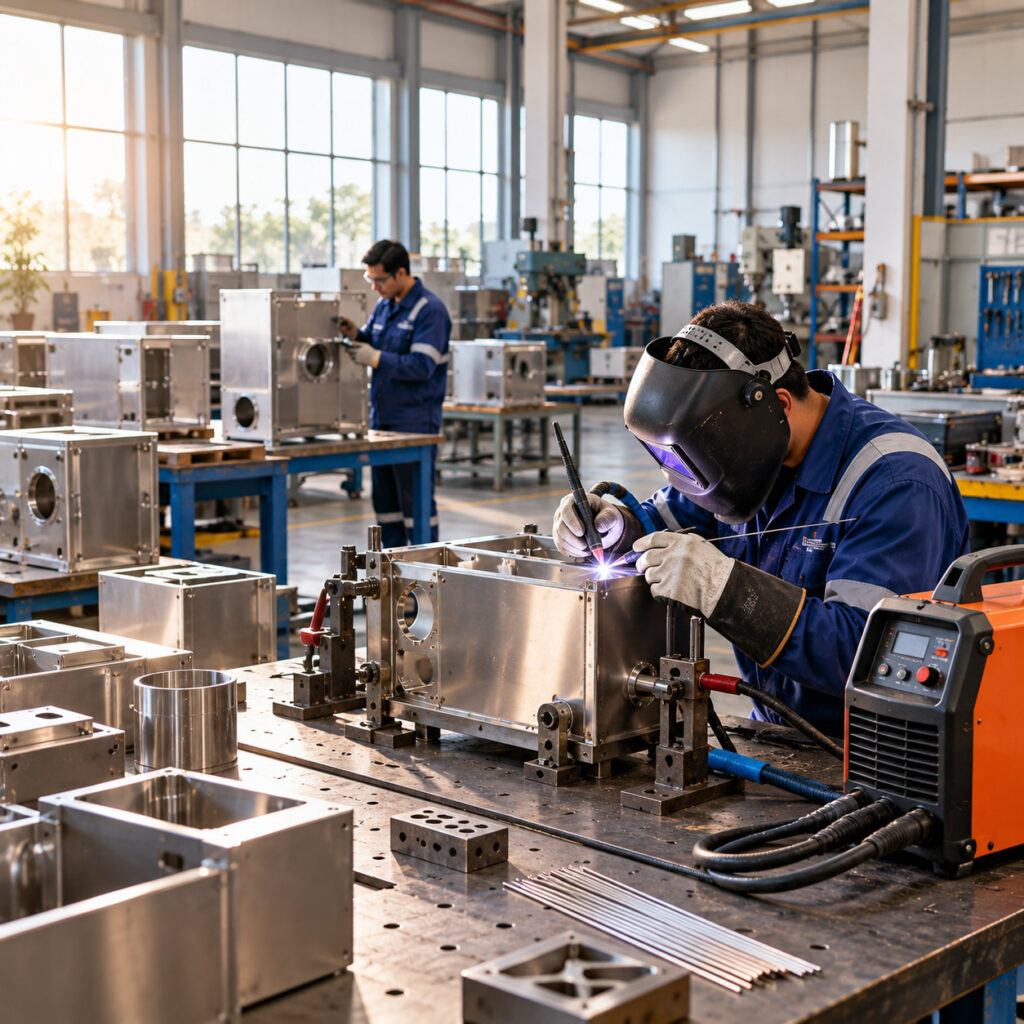
MIG Welding for Repetitive Fabrication
MIG/MAG welding is commonly used in suitable fabrication and manufacturing applications where wire is continuously fed through a welding torch.
This process can be useful for producing metal frames, brackets, enclosures, machinery components and structural assemblies. Depending on the application, it can support efficient production across repetitive welding tasks.
When selecting JASIC MIG welding machines, consider the material, wire type, wire diameter, shielding gas, required output and expected operating hours.
For higher-volume operations, buyers should also assess whether the application would benefit from synergic controls, pulse functionality or a separate wire feeder. These features vary by model and should be selected according to the actual welding procedure.
A complete MIG setup may include the power source, wire-feeding system, torch, work-return cable, compatible filler wire and appropriate gas equipment.
Ensuring that these components work together is important for establishing a consistent production process.
TIG Welding for Controlled, Detailed Work
Some fabrication tasks demand greater control over the welding arc and heat input. TIG welding can be appropriate for applications where precision, weld appearance and control over the molten weld pool are important.
Examples may include selected stainless steel fabrications, thin metal components, equipment assemblies and precision repair work.
When choosing JASIC TIG welding equipment, first determine whether the application requires DC TIG, AC/DC TIG or pulse functionality.
DC TIG is commonly used for suitable steels and stainless steels, while AC TIG is often considered for aluminium applications. The correct choice depends on the base material, joint requirements and machine specifications.
Other selection factors include:
- High-frequency or alternative arc-start requirements
- Pulse settings, where needed
- Available torch and cooling arrangements
- Required welding current
- Electrode and filler-material compatibility
- Power supply and duty cycle
For workshops handling several types of work, choosing the right TIG configuration can help operators manage different fabrication requirements without selecting features they do not need.
MMA Welding for Construction and Maintenance
Manual metal arc welding, also known as MMA or stick welding, remains useful in many industrial environments because of its straightforward equipment arrangement and broad range of suitable applications.
It can be considered for structural work, repair tasks, site fabrication and maintenance where the selected electrode and welding procedure are appropriate.
When sourcing JASIC MMA welding machines, review the required current range, electrode types, input power and operating duty cycle.
Additional functions such as hot start, arc force and anti-stick may be available on selected models. Their usefulness depends on the welding task and operator requirements.
Portable inverter-based machines may be suitable for certain maintenance and installation jobs, while higher-output equipment may be needed for more demanding work.
The important consideration is whether the machine can perform the intended procedure within its specified operating limits.
Plasma Cutting for Metal Preparation
Welding quality begins before the arc is struck. Poorly prepared edges, inaccurate dimensions and unsuitable joint gaps can create problems during fabrication.
Plasma cutting can support metal preparation by cutting electrically conductive materials using a plasma arc. It is used in suitable applications involving plate cutting, component preparation and fabrication work.
When evaluating JASIC plasma cutting machines, consider the metal type, thickness, required cut quality, operating frequency and available compressed-air supply.
The required cutting capacity should be assessed using the manufacturer’s specifications for the intended material and operating conditions. Maximum severance capacity should not automatically be treated as the normal production cutting capacity.
Buyers should also account for the torch, consumable parts, electrical requirements, air quality and suitable protective equipment.
A properly specified cutting system can help integrate material preparation into the wider fabrication workflow.
Multi-Process Equipment for Flexible Workshops
Some businesses regularly move between different welding tasks. A maintenance workshop, for example, may need stick welding for repairs and TIG welding for more controlled work.
A multi-process machine can be worth considering when a single power source is designed to support the required processes.
JASIC’s product portfolio includes multi-process welding systems, although available processes and features differ between models.
Before selecting JASIC multi-process welders, compare the actual capabilities of the machine with the tasks performed in your workshop.
Ask whether the selected model supports the necessary processes, output ranges, torches, feeders and operating settings. Also consider how frequently the processes will be changed and whether a dedicated machine would be more suitable for high-volume production.
Multi-process capability is most valuable when it meets a genuine operational need rather than simply adding unused features to the equipment specification.
Electrical Supply and Operating Conditions
An otherwise suitable welding machine can become impractical if its electrical requirements do not match the worksite.
Before purchasing, confirm the available single-phase or three-phase supply, input voltage, current requirements and any installation restrictions. These details are especially important when equipment will be moved between a workshop and a construction site.
For industrial applications, also review ventilation, ambient temperature, dust exposure, cable routing and access for routine maintenance.
When choosing industrial welding machines, consider the expected operating schedule as well as the electrical supply. A machine used intermittently for repairs has different demands from one operating throughout a production shift.
The equipment’s rated output, duty cycle and environmental limitations should guide the final selection.
Accessories and Consumables Complete the Setup
A welding machine is only one part of a functional welding station.
Depending on the process, the complete setup may require torches, cables, electrode holders, work-return clamps, wire feeders, welding helmets and suitable consumables.
JASIC’s product categories include welding torches, plasma cutting torches, protective equipment, welding wires and electrodes for different material applications.
When ordering JASIC welding accessories, check the equipment model and connection requirements before selecting components. Similar-looking accessories may not always be interchangeable.
Consumables should also match the base material, welding process and approved procedure. Wire composition, electrode classification, diameter and shielding gas requirements can all influence suitability.
Planning these supporting items alongside the machine helps avoid delays caused by missing or incompatible components.
Equipment Selection for Different Industries
JASIC equipment can be evaluated for a variety of applications, provided the selected model is suitable for the specific task.
Metal fabrication: MIG systems may be suitable for repetitive assembly, while TIG equipment can support more controlled welding work.
Construction: MMA machines and appropriately rated MIG systems may be considered for structural and installation tasks.
Industrial maintenance: Portable equipment or suitable multi-process systems can support a range of repair activities.
Manufacturing: Production teams should assess duty cycle, operating consistency, process requirements and workstation integration.
Metal preparation: Plasma cutters can support cutting operations where their specifications match the material and required cut quality.
For businesses comparing JASIC welding solutions, matching the machine to the intended application is more useful than selecting equipment based solely on a general industry label.
Sourcing JASIC Equipment Through Fabricast
Fabricast lists JASIC welding equipment across categories that include MMA, MIG, TIG and submerged arc welding. Its JASIC range includes models such as the ARC 200 PFC, ARC 400 series, MIG 500, TIG 300P and TIG 400 models.
The correct product depends on the application, current requirements, electrical supply and available configuration. Buyers should confirm the specifications and availability of the individual model before ordering.
When contacting JASIC welding equipment suppliers, prepare the material details, welding process, required output, power supply and expected workload. If accessories or consumables are also required, include them in the enquiry.
This makes it easier to assess the complete equipment requirement and compare suitable options.
Visit the JASIC product range at Fabricast or submit your enquiry through the Fabricast Request a Quote page.
Conclusion
Selecting JASIC welding equipment is a practical decision that should reflect the materials, welding procedures, production demands and operating conditions of the intended application.
MIG, TIG, MMA, plasma cutting and multi-process systems each serve different purposes. Comparing output specifications, electrical requirements, duty cycle, accessories and consumables helps businesses choose machinery that fits their workflow.
For companies exploring JASIC Welding Equipment, Fabricast provides a product range for industrial and fabrication applications. Share your technical requirements and intended use to help identify a suitable equipment configuration.
Call to Action
Looking for JASIC welding equipment for your workshop or industrial project?
Contact Fabricast to discuss your requirements for MIG, TIG, MMA, multi-process welding machines or plasma cutters. Provide your material specifications, welding process and operating needs to request a suitable quotation.
Frequently Asked Questions
1. What types of JASIC welding equipment are available?
JASIC’s product portfolio includes MIG, TIG, MMA, multi-process welding machines, plasma cutters, handheld laser welding systems, accessories and consumables. Specific models and features vary.
2. How do I choose between MIG, TIG and MMA welding?
The choice depends on the base material, thickness, joint requirements, production speed, working conditions and desired weld characteristics.
3. Are JASIC machines suitable for industrial applications?
Selected JASIC models are designed for professional and industrial use. Confirm the output, duty cycle, electrical requirements and other specifications for the intended application.
4. What should I check before purchasing a JASIC welding machine?
Review the welding process, material specifications, required output, power supply, duty cycle, operating environment and compatibility with accessories and consumables.
5. How can I enquire about JASIC equipment through Fabricast?
Visit Fabricast’s JASIC product page or submit a quotation request with the model, application, technical requirements and quantity needed.
