
Modern metal fabrication demands more than simply cutting material. Manufacturers need speed, repeatability, accuracy, efficient material usage and equipment that can adapt to changing production requirements. As businesses across the GCC invest in more advanced fabrication capabilities, fiber laser technology has become an important part of modern metalworking operations.
BODOR laser cutting machines are designed to address these requirements with solutions covering sheet metal, tubes, profiles and automated production processes. Fabricast supplies BODOR equipment across key GCC markets, including the UAE, Qatar and Saudi Arabia, giving industrial customers access to a broad range of laser cutting technologies.
Rather than viewing a laser cutter simply as another piece of workshop equipment, manufacturers can consider it a production platform capable of improving how materials move from raw stock to finished components.
Why Laser Cutting Matters in Modern Fabrication
Traditional cutting methods can remain useful for particular applications, but modern production environments increasingly require greater control over accuracy, repeatability and production speed.
Fiber laser cutting uses a concentrated laser beam to process metal with a high degree of control. This makes the technology suitable for producing components with detailed geometries, consistent dimensions and clean edges.
For manufacturers handling frequent production runs, the benefits extend beyond the individual cut. Consistent processing can help reduce rework, improve workflow planning and make downstream operations more predictable.
The result is a production process where cutting becomes a more controlled part of the overall manufacturing Chain.
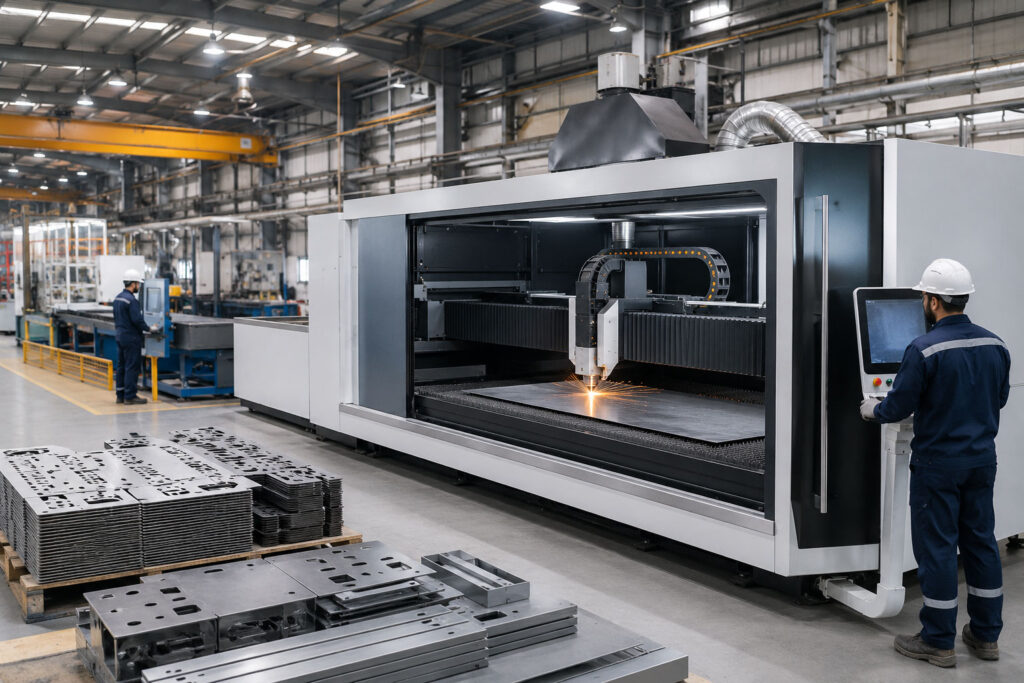
A BODOR Machine for Different Production Requirements
One of the major advantages of the BODOR range is its breadth. The manufacturer offers dedicated solutions for different types of metal processing rather than relying on one machine configuration for every application. Its current range includes sheet metal, tube, sheet-and-tube, profile cutting and laser welding equipment.
Fabricast’s BODOR portfolio similarly includes several machine families designed for different production requirements.
Sheet Metal Laser Cutting
Sheet metal fabrication covers a wide variety of industries, from general engineering and equipment manufacturing to construction-related components and industrial structures.
Fabricast offers BODOR sheet cutting models including the A, P, C, i, L, B, H, G and ROCUT series. These machines address different requirements, from entry-level production to high-performance and ultra-large-format processing.
For example, the BODOR A is positioned as an entry-level fiber laser solution, while the P is designed for higher-performance sheet processing. The C provides a fully enclosed configuration, while the H and G are intended for large-format applications.
This range allows businesses to evaluate equipment according to their material dimensions, production volume, workspace and future growth plans.
Tube and Profile Cutting Capabilities
Metal fabrication is not limited to flat sheets. Tubes, pipes, structural profiles and other three-dimensional materials are essential across construction, engineering, furniture, infrastructure and industrial manufacturing.
BODOR’s tube cutting range includes models such as the M, T, K and Q series. Fabricast describes these solutions for applications ranging from high-performance tube processing to smaller tube production and automated material handling.
For companies processing structural materials, profile cutting can provide another important capability. Fabricast’s BODOR portfolio includes the U10 and HCut series, with solutions intended for profiles, tubes, sheets and structural steel applications.
This flexibility can be particularly valuable for fabrication businesses that work with multiple material formats rather than specializing in only flat sheet production.
Automation Can Change the Production Workflow
Machine performance is only one part of production efficiency. Loading, unloading and material handling can also influence how effectively a cutting system operates.
BODOR offers a range of automation equipment, including iLoader, iTower, iTrans and iTransTower for sheet-processing workflows, along with loading and transfer systems for tube cutting.
Automation can help reduce repetitive manual handling and improve material flow around the cutting machine. In higher-volume environments, this can become especially important because production capacity is influenced not only by cutting speed but also by how quickly materials can be prepared and moved through the process.
An automated setup can therefore be considered as part of a broader production strategy rather than simply an optional machine accessory.
Improving Material Utilisation
Material cost is an important consideration for metal fabricators. Even small amounts of unnecessary scrap can become significant when multiplied across thousands of components.
Modern laser cutting workflows can support more efficient nesting and material planning. BODOR’s ROCUT system, for example, is designed as an automated coiled-sheet fiber laser production line incorporating processes such as uncoiling, leveling and cutting.
For manufacturers working with high volumes, improving how material is positioned and processed can have a meaningful effect on production economics.
However, the right solution depends on the material type, thickness, component geometry, production quantity and required output. Equipment selection should therefore begin with the actual manufacturing process rather than simply choosing the highest-powered machine available.
Applications Across Industrial Manufacturing
The versatility of BODOR laser cutting machines makes them relevant to many metalworking environments.
Potential applications include:
- General sheet metal fabrication
- Structural steel processing
- Industrial equipment manufacturing
- Metal furniture production
- Engineering components
- Construction-related fabrication
- Tube and pipe processing
- Automotive components
- Machinery parts
- Custom metal fabrication
The best machine configuration depends on the specific production requirements. A business focused primarily on flat sheets may require a different setup from a manufacturer processing tubes, structural profiles or mixed material formats.
Choosing the Right BODOR Laser Cutting Machine
Selecting industrial cutting equipment should involve more than comparing machine prices.
Businesses should first consider the materials they regularly process. Mild steel, stainless steel, aluminium and other metals can have different cutting requirements.
Next, evaluate material dimensions and thickness. A workshop producing small components may have very different requirements from a company processing large structural plates.
Production volume is another major consideration. A machine suitable for occasional fabrication may not be the best choice for continuous industrial production.
Businesses should also evaluate:
- Required cutting area
- Material thickness
- Production volume
- Part complexity
- Sheet or tube requirements
- Automation requirements
- Available workshop space
- Operator requirements
- Maintenance and technical support
- Future production expansion
BODOR’s product range provides multiple configurations, allowing equipment selection to be aligned with the application instead of forcing every manufacturer into the same machine format.
Why Local Distribution and Support Matter
Purchasing advanced industrial equipment is only the beginning of the investment. Installation, training, maintenance, spare parts and technical assistance can all influence long-term equipment performance.
Fabricast operates across several GCC markets and lists locations in the UAE, Qatar and Saudi Arabia, supporting its industrial equipment distribution activities.
For businesses evaluating laser cutting technology, working with an established regional supplier can make it easier to discuss application requirements, machine configurations and after-sales considerations before making a purchasing decision.
Building a More Efficient Fabrication Operation
The strongest reason to invest in modern laser cutting technology is not simply owning a more advanced machine. It is the opportunity to create a more efficient and predictable production workflow.
A properly selected laser cutting system can become an important link between material preparation, cutting, fabrication and final assembly. When combined with suitable automation and an appropriate production strategy, the technology can help manufacturers pursue greater consistency and productivity.
BODOR’s broad range of sheet, tube, profile and automated solutions gives fabricators multiple options for developing that workflow.
Conclusion
BODOR laser cutting machines offer manufacturers a broad selection of technologies for modern metal fabrication, from sheet and tube cutting to large-format processing, structural profiles and automated material handling.
The right machine is ultimately determined by the application. Material type, thickness, dimensions, production volume, part complexity and automation requirements should all be considered before investing in a system.
For businesses seeking to improve precision, production consistency and workflow efficiency, modern fiber laser cutting can be a valuable step toward a more capable fabrication operation. With Fabricast’s regional presence and BODOR equipment portfolio, manufacturers in the GCC can explore solutions designed around their specific metalworking requirements.
Call to Action
Looking for the right BODOR laser cutting machine for your production needs? Contact Fabricast to discuss your application, material requirements and suitable machine configuration with an experienced industrial equipment team.
