
Hyundai Welding Machine Distributors help industrial businesses source dependable welding solutions for demanding fabrication, construction, shipbuilding, energy, and manufacturing applications. For companies working across the GCC, choosing the right welding products is not simply a purchasing decision—it affects weld quality, production continuity, consumable usage, project schedules, and long-term operating costs. Fabricast supports industrial customers with Hyundai welding products and technical guidance across the UAE, Qatar, Saudi Arabia, and Kuwait.
Rather than approaching welding procurement one product at a time, businesses can achieve better results by considering the entire welding process: base material, joint design, welding method, filler metal, production volume, operator requirements, storage, and supply continuity.
This guide examines how to build that more structured procurement strategy.
Why Welding Procurement Should Begin With the Weld
A common purchasing approach starts with a machine specification or product catalogue.
A better approach starts with the weld itself.
Before selecting equipment or consumables, an engineering or procurement team should identify the material being joined, required mechanical properties, welding position, production environment, applicable welding procedure, and expected production volume.
These details determine what the operation actually requires.
Hyundai Welding’s current product portfolio includes SMAW electrodes, GMAW solid wire, GTAW TIG rods, FCAW flux-cored wire, metal-cored wire, submerged-arc welding wire, and submerged-arc flux.
Working with experienced industrial welding suppliers can therefore help businesses move from product-based purchasing toward application-based selection.
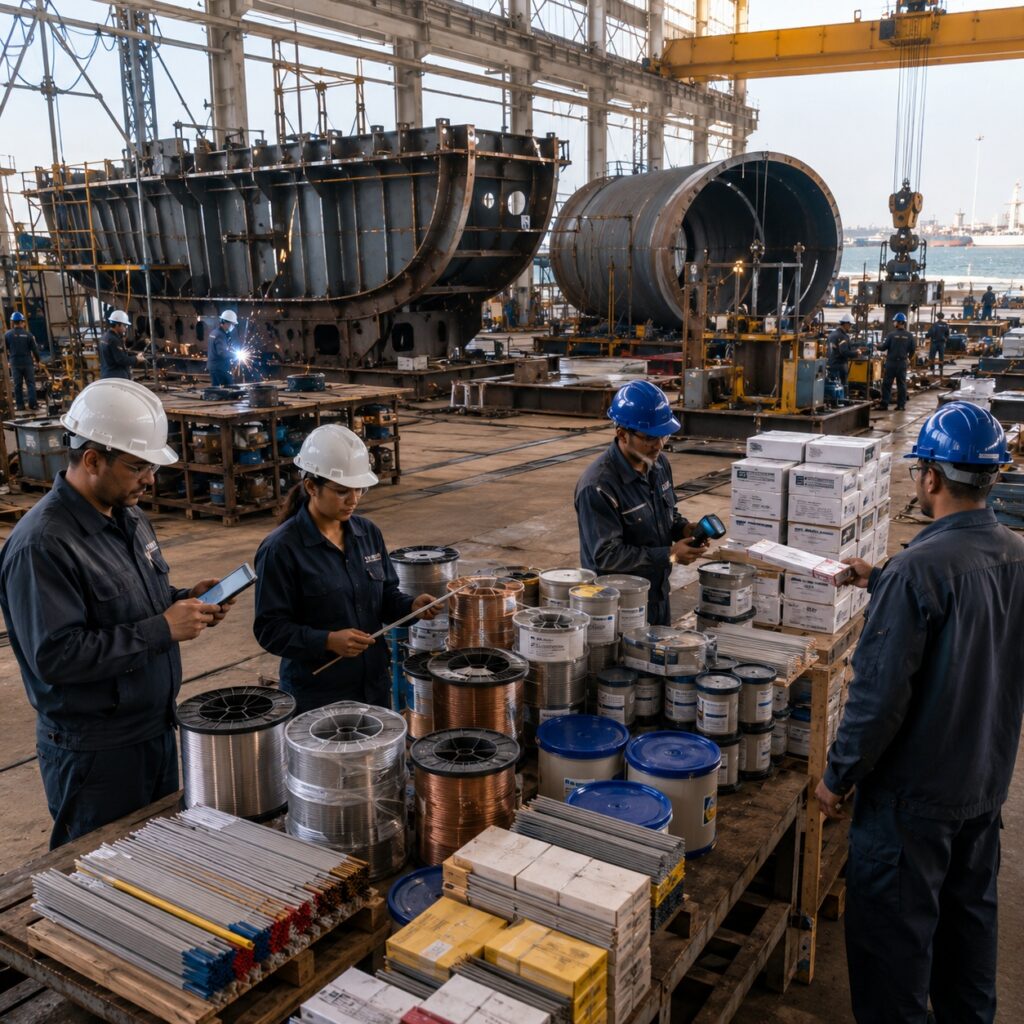
Build a Welding Process Map Before Ordering
For a fabrication business handling multiple projects, purchasing requirements can quickly become complicated.
One project might involve structural carbon steel. Another may require stainless steel fabrication, while a third involves components designed for demanding service conditions.
Creating a simple welding process map can help.
Document:
- Base materials being welded
- Welding processes used
- Material thickness ranges
- Welding positions
- Filler metals required
- Monthly consumption
- Storage requirements
- Project specifications
This information gives Hyundai Welding Machine Distributors a clearer picture of what the customer actually needs.
It can also reduce unnecessary product variation within the workshop.
SMAW Electrodes: Selection Should Follow the Application
Shielded Metal Arc Welding remains important across construction, repair, maintenance, structural work, and many field applications.
However, electrodes should not be treated as interchangeable products.
Selection needs to consider the base material, welding position, mechanical requirements, procedure specifications, storage conditions, and project requirements.
Hyundai Welding lists SMAW stick electrodes among its core product categories.
Companies purchasing Hyundai welding electrodes should therefore confirm the required classification and application before ordering rather than selecting solely according to electrode diameter or price.
This becomes especially important on critical projects where welding procedures specify particular consumable classifications.
GMAW Solid Wire for Production-Oriented Fabrication
Manufacturing and fabrication facilities often need welding processes capable of supporting repetitive production.
GMAW solid wire can be particularly relevant where controlled wire feeding and productive welding are required.
Hyundai Welding includes GMAW solid wire within its official consumables portfolio.
When evaluating Hyundai MIG welding wire, procurement teams should consider more than the cost per spool.
They should also examine:
- Base material compatibility
- Wire classification
- Diameter
- Shielding gas requirements
- Welding parameters
- Feeding performance
- Storage conditions
A small purchasing decision can influence thousands of welds over the course of a production contract.
FCAW Can Change the Productivity Equation
Flux-cored arc welding is widely relevant to industrial fabrication where productivity and deposition performance are important.
The process can be particularly useful in heavy fabrication environments, depending on the material, welding procedure, position, and project requirements.
Hyundai Welding manufactures FCAW flux-cored wire across several material categories, including mild and high-tensile steels, low-temperature service steels, stainless steels, and nickel-based alloys.
For companies evaluating Hyundai flux cored wire, the key question should be whether the selected consumable matches the welding procedure and required mechanical properties.
Purchasing teams should involve welding engineers or qualified technical personnel when specifications are critical.
TIG Rod Selection Requires Precision
TIG welding is commonly associated with applications where control and weld quality are particularly important.
The filler material should be selected according to the base material, service conditions, required mechanical properties, and welding procedure.
Hyundai Welding includes GTAW TIG rods in its product portfolio.
For businesses sourcing Hyundai TIG welding rods, correct identification and storage are especially important because similar-looking filler materials may serve very different applications.
Organized inventory practices can help prevent incorrect consumables from reaching the welding station.
Submerged Arc Welding for Heavy Production
Submerged Arc Welding can play an important role in large-scale fabrication where long welds and high productivity are required.
Typical applications may include structural fabrication, pressure-related manufacturing, heavy engineering, and shipbuilding, depending on the approved process.
Hyundai Welding’s H-14 submerged-arc wire, for example, is classified for carbon-steel applications and lists shipbuilding and steel structures among its typical uses.
When sourcing submerged arc welding consumables, businesses should evaluate wire and flux as a coordinated system rather than treating them as unrelated purchases.
Consumable Standardization Can Reduce Workshop Complexity
A growing fabrication company may gradually accumulate dozens of consumable variants.
Some are required frequently. Others may have been purchased for a single project and remain in storage.
This can create several problems:
- More complicated inventory
- Higher stockholding
- Increased risk of incorrect selection
- Difficult purchasing forecasts
- Greater storage requirements
Standardization can help.
Companies can review recurring projects and identify which approved consumables cover the majority of their workload.
The objective is not to eliminate specialized products. It is to reduce unnecessary variation while maintaining compliance with applicable procedures.
A knowledgeable welding consumables distributor can support this process by helping customers understand product categories and intended applications.
Storage Is Part of Welding Quality
Purchasing genuine, suitable welding consumables is only half of the job.
They must also reach the welding station in appropriate condition.
Storage and handling requirements vary by consumable type and manufacturer guidance. Workshops should establish procedures appropriate to the products they use.
A practical inventory system can include:
- Clearly identified storage locations
- Batch or lot traceability where required
- Controlled stock rotation
- Protection from unsuitable environmental exposure
- Separation of different classifications
- Defined handling procedures
Good storage management protects the value of professional welding consumables and helps maintain consistency between procurement and production.
Procurement Teams Should Track Consumption, Not Just Stock
Traditional inventory systems answer one question:
“How much material do we have?”
Better welding procurement asks another:
“How quickly are we using it?”
Tracking consumption by project, welding process, or production department can reveal useful patterns.
A company might discover that one wire diameter represents most of its monthly usage, while several rarely used products occupy valuable warehouse space.
Consumption data can improve:
- Purchasing forecasts
- Reorder quantities
- Warehouse utilization
- Project costing
- Emergency stock planning
This turns welding procurement into a measurable production function.
Avoid Emergency Purchasing
Few things disrupt welding procurement more than discovering that an essential consumable is unavailable halfway through a project.
Emergency purchasing can create higher costs, rushed technical decisions, and production delays.
Companies working on continuous fabrication programs should establish minimum stock levels for critical consumables.
The appropriate level depends on consumption rate, project schedules, supplier lead times, and storage limitations.
Working with dependable Hyundai welding product suppliers can help companies plan supply requirements before shortages affect production.
Traceability Matters on Critical Projects
Certain industrial projects may require documentation relating to consumables, classifications, batches, or quality records.
Requirements vary according to the project and applicable standards.
Procurement teams should understand documentation requirements before placing an order rather than attempting to collect records after materials have already entered production.
This is especially relevant to projects involving:
- Oil and gas
- Shipbuilding
- Heavy structures
- Process equipment
- Energy infrastructure
- Specialized manufacturing
Documentation and traceability should form part of the purchasing specification whenever required.
Supporting Shipbuilding and Structural Fabrication
Welding consumables play a central role in industries where large volumes of steel must be joined consistently.
Hyundai Welding specifically identifies shipbuilding and steel structures among applications for its H-14 submerged-arc welding wire.
Large fabrication environments may use multiple welding processes across different stages of production.
For example, one facility might combine SMAW for particular site activities, FCAW for productive fabrication, GMAW for manufacturing work, and SAW for long automated welds.
This makes access to a broad industrial welding consumables range particularly useful for businesses handling diverse projects.
Don’t Select Consumables by Price Alone
Price is important in industrial procurement, but the lowest unit cost does not automatically create the lowest welding cost.
Consider the broader equation.
Poor process compatibility can contribute to:
- Additional cleanup
- Higher spatter
- Slower production
- Increased rework
- Greater consumable waste
- More operator time
The correct purchasing metric should therefore consider cost per completed weld or fabricated component—not merely cost per kilogram of consumable.
Why Distributor Knowledge Adds Value
An industrial distributor should do more than move products from warehouse to customer.
Customers may need assistance identifying suitable product categories, checking availability, planning quantities, or coordinating recurring supply.
Fabricast’s existing Hyundai offering identifies distribution across the UAE, Qatar, Saudi Arabia, and Kuwait and lists Hyundai consumables among its regional product offering.
This regional presence can be particularly relevant to companies managing projects across multiple GCC markets.
Creating a Procurement Specification
Before requesting a quotation, businesses can prepare a simple procurement specification.
Include:
- Welding process
- Base material
- Consumable classification
- Diameter
- Required quantity
- Packaging requirement
- Project location
- Delivery schedule
- Documentation requirements
- Applicable welding procedure information
Providing accurate information helps Hyundai Welding Machine Distributors respond with a more relevant solution.
It also reduces unnecessary back-and-forth between purchasing and technical teams.
Why Fabricast for Hyundai Welding Products?
Fabricast supplies Hyundai welding consumables across UAE, Qatar, Saudi Arabia, and Kuwait. Its published Hyundai range includes FCAW products, MIG wires, stick electrodes, and other consumable solutions for industrial applications.
For industrial customers, the value of working with Fabricast is the ability to approach welding procurement as part of the larger fabrication process.
Instead of asking only, “What product is available?”, businesses can begin with more useful questions:
What are we welding? Which process are we using? What classification is required? How much will we consume? When must it arrive?
That approach supports more predictable procurement and better production planning.
Conclusion
Successful welding procurement is not about filling a warehouse with products. It is about ensuring that the correct consumable reaches the correct welding operation when production needs it.
Businesses should coordinate engineering, welding, procurement, warehouse, and production teams when selecting and managing welding products. Process mapping, consumable standardization, consumption tracking, traceability, appropriate storage, and supply planning can all contribute to more efficient operations.
For businesses searching for Hyundai Welding Distributors, Fabricast provides access to Hyundai welding consumables across major GCC markets and supports industrial customers with solutions for diverse welding requirements.
Frequently Asked Questions
1. What is the focus keyphrase?
The focus keyphrase is Hyundai Welding Distributors. It is shorter than the supplied keyword and stays within the recommended four-content-word range for SEO plugins.
2. What products does Hyundai Welding manufacture?
Hyundai Welding’s official portfolio includes SMAW stick electrodes, GMAW solid wire, GTAW TIG rods, FCAW flux-cored wire, metal-cored wire, SAW wire, and SAW flux.
3. Where does Fabricast supply Hyundai welding products?
Fabricast currently presents Hyundai welding distribution and supply coverage across the UAE, Qatar, Saudi Arabia, and Kuwait.
4. How should I select Hyundai welding consumables?
Selection should be based on welding process, base material, required classification, mechanical requirements, welding procedure, operating environment, and project specifications.
5. Why should businesses plan consumable purchases in advance?
Forecasting reduces emergency purchasing and helps maintain adequate inventory for production schedules while avoiding unnecessary stock.
